Synonym for hiatus options help you describe temporary breaks, pauses, or gaps in life smoothly. Imagine your favorite TV show suddenly going offline for six long months. You need a precise word to describe that empty gap without sounding repetitive.
A student writing an essay or a blogger drafting a post can use a synonym for hiatus to keep their text dynamic. Using varied vocabulary keeps readers engaged while showing high English fluency.
Words like pause, break, or gap are commonly used because taking time off is a universal human experience. Learning these terms instantly boosts your daily communication and professional writing.
What Does “Hiatus” Really Mean?
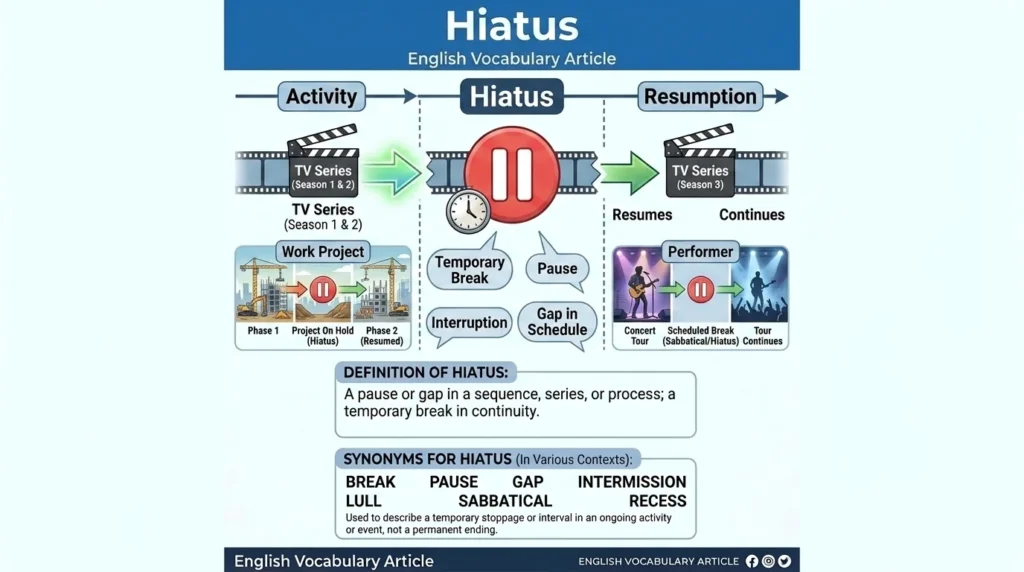
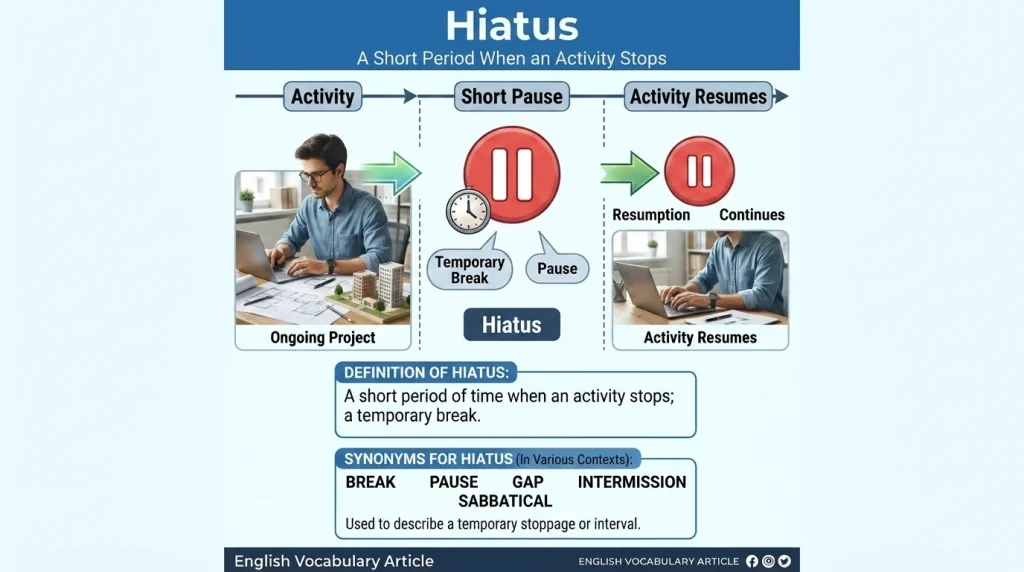
The word hiatus refers to a temporary break, interruption, or gap in a continuous activity or process. It usually carries a neutral or peaceful tone, implying that whatever stopped will eventually start again. Native speakers use it to describe work breaks, show pauses, or career gaps.
Part of Speech: Noun
Definition: A pause or gap in a sequence, series, or process.
Connotative Meaning
Connotation is the emotional feeling or cultural idea that a word invokes in addition to its literal meaning.
- Positive tone: A restful pause that brings energy back.
- Negative tone: An unwanted delay or disruption in momentum.
- Neutral tone: A simple scheduled gap in a timetable.
Etymology
The word hiatus comes directly from the Latin word hiatus, which means “opening,” “gaping,” or “chasm,” originating from hiare (to gape or stand open).
- Old English (450–1100): The word did not exist in Old English; native Germanic terms like stund (time/gap) were used instead.
- Middle English (1100–1500): Not active in Middle English; gaps were referred to as breaks or openings.
- Modern English (1500–Present): Entered English in the early 1600s, initially referring to physical openings or missing parts in text, before adopting its modern meaning of a temporal pause.
Pronunciation (US & UK – IPA)
- US: /ˈhaɪ.eɪ.t̬əs/
- UK: /haɪˈeɪ.təs/
Syllables:
hi-a-tus
Affixation Pattern:
Root-based noun (Latin origin).
- Root: Hia (to gape)
- Prefix: None
- Suffix: -tus (Latin suffix forming action/state nouns)
Synonyms List
Break (Noun) — US: /breɪk/ | UK: /breɪk/
Meaning: A short period of time when an activity stops.
Tone/Register: Informal / Everyday
Example:
We took a short break from our study session to grab some warm coffee.
She decided to take a career break to travel the world.
Pause (Noun) — US: /pɑːz/ | UK: /pɔːz/
Meaning: A temporary stop in action or speech.
Tone/Register: Neutral / Conversational
Example:
There was a brief pause in the meeting while the presenter loaded his slides.
He took a long pause before answering the difficult question.
Intermission (Noun) — US: /ˌɪn.t̬ɚˈmɪʃ.ən/ | UK: /ˌɪn.təˈmɪʃ.ən/
Meaning: A short interval between parts of a play, film, or concert.
Tone/Register: Formal / Cultural
Example:
Guests walked out to the lobby during the fifteen-minute theater intermission.
The band played two full sets with a quick intermission between them.
Respite (Noun) — US: /ˈres.pɪt/ | UK: /ˈres.paɪt/
Meaning: A short period of rest or relief from something difficult.
Tone/Register: Formal / Literary
Example:
The cooler evening breeze provided a welcome respite from the intense summer heat.
She worked without respite until the urgent project was finally finished.
Gap (Noun) — US: /ɡæp/ | UK: /ɡæp/
Meaning: A space of time where an activity is interrupted.
Tone/Register: Neutral / General
Example:
He explained the two-year gap in his employment history during the job interview.
There is a noticeable gap between the release of the two movie sequels.
Interruption (Noun) — US: /ˌɪn.t̬əˈrʌp.ʃən/ | UK: /ˌɪn.təˈrʌp.ʃən/
Meaning: An event that briefly stops something from continuing.
Tone/Register: Neutral / Business
Example:
The construction noise outside caused a constant interruption to our phone calls.
She finished her online lesson despite a sudden power interruption.
Interval (Noun) — US: /ˈɪn.t̬ɚ.vəl/ | UK: /ˈɪn.tə.vəl/
Meaning: A period of time between two events or actions.
Tone/Register: Neutral / Technical
Example:
The train arrives at regular intervals throughout the early morning hours.
They sat together in the lobby during the concert interval.
Lacuna (Noun) — US: /ləˈkuː.nə/ | UK: /ləˈkjuː.nə/
Meaning: A missing part, gap, or space in a record or argument.
Tone/Register: Academic / Formal
Example:
The historian pointed out an important lacuna in the ancient historical manuscript.
Her detailed report filled a major knowledge lacuna for the research team.
Recess (Noun) — US: /ˈriː.ses/ | UK: /rɪˈses/
Meaning: A temporary withdrawal or suspension from customary work or business.
Tone/Register: Formal / Legal / Educational
Example:
Congress went into a summer recess before voting on the proposed bill.
Children ran outside to play on the field during their afternoon recess.
Halt (Noun) — US: /hɑːlt/ | UK: /hɔːlt/
Meaning: A temporary or permanent stop in movement or progress.
Tone/Register: Neutral / Direct
Example:
Production came to a sudden halt when the main delivery truck broke down.
The factory manager called for a brief halt in assembly work.
Discontinuation (Noun) — US: /ˌdɪs.kən.tɪn.juˈeɪ.ʃən/ | UK: /ˌdɪs.kən.tɪn.jʊˈeɪ.ʃən/
Meaning: The act of stopping something from continuing.
Tone/Register: Formal / Business
Example:
Customers were upset about the sudden discontinuation of their favorite product line.
The doctor recommended a gradual discontinuation of the strong medicine.
Suspension (Noun) — US: /səˈspen.ʃən/ | UK: /səˈspen.ʃən/
Meaning: The temporary setting aside or stopping of a function, service, or rule.
Tone/Register: Formal / Administrative
Example:
The referee ordered a temporary suspension of the match due to severe lightning.
The city announced a quick suspension of bus services during the storm.
Layoff (Noun) — US: /ˈleɪ.ɑːf/ | UK: /ˈleɪ.ɒf/
Meaning: A period of inactivity or temporary discharge from work.
Tone/Register: Informal / Corporate
Example:
The athlete returned to professional training after a long injury layoff.
Many factory workers faced a temporary layoff during the economic slowdown.
Breathing Space (Noun) — US: /ˈbriː.ðɪŋ speɪs/ | UK: /ˈbriː.ðɪŋ speɪs/
Meaning: A short period of rest that allows someone to recover energy or regain control.
Tone/Register: Informal / Conversational
Example:
Finishing the project early gave the team some much-needed breathing space.
She took a weekend trip to gain some breathing space from her busy life.
Letup (Noun) — US: /ˈlet.ʌp/ | UK: /ˈlet.ʌp/
Meaning: A reduction in intensity or a temporary pause in heavy activity.
Tone/Register: Informal / Daily
Example:
The heavy rain continued all afternoon without any sign of a letup.
We worked for ten straight hours without a single letup.
Stoppage (Noun) — US: /ˈstɑː.pɪdʒ/ | UK: /ˈstɒp.ɪdʒ/
Meaning: An intentional halting of work or physical movement.
Tone/Register: Business / Industrial
Example:
The sudden work stoppage delayed the completion of the new bridge.
The referee added extra time to the match due to an injury stoppage.
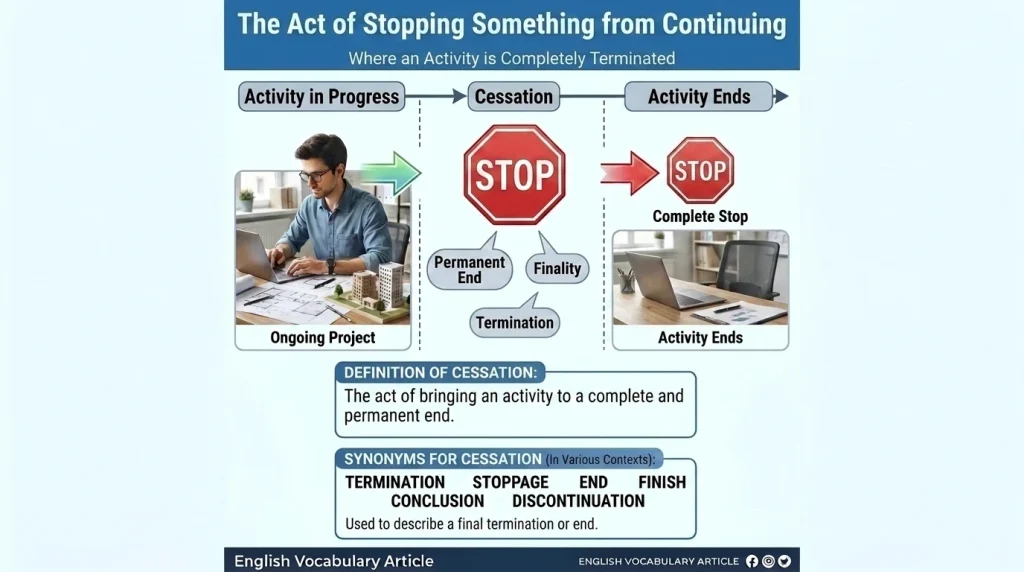
Cessation (Noun) — US: /seˈseɪ.ʃən/ | UK: /seˈseɪ.ʃən/
Meaning: A complete or temporary stopping of an action or condition.
Tone/Register: Formal / Official
Example:
Both nations agreed to an immediate cessation of military operations.
The doctor advised a total cessation of smoking for better lung health.
Lull (Noun) — US: /lʌl/ | UK: /lʌl/
Meaning: A temporary period of quiet, calm, or reduced activity.
Tone/Register: Conversational / Descriptive
Example:
There was a comfortable lull in the conversation as everyone enjoyed their food.
Store owners prepared for the holiday rush during the afternoon lull.
Interstice (Noun) — US: /ɪnˈtɝː.stɪs/ | UK: /ɪnˈtɜː.stɪs/
Meaning: A small, intervening space of time between events.
Tone/Register: Academic / Literary
Example:
He managed to write his entire novel in the small interstices of his workday.
She studied useful vocabulary words in the short interstices between classes.
Moratorium (Noun) — US: /ˌmɔːr.əˈtɔːr.i.əm/ | UK: /ˌmɒr.əˈtɔːri.əm/
Meaning: A temporary prohibition or authorized delay of an activity.
Tone/Register: Legal / Political
Example:
The local government placed a temporary moratorium on new building permits.
The university called for a moratorium on major exam changes this year.
Downtime (Noun) — US: /ˈdaʊn.taɪm/ | UK: /ˈdaʊn.taɪm/
Meaning: Time during which a machine or person is not actively working.
Tone/Register: Informal / Technical
Example:
It is important to schedule regular personal downtime to avoid burning out.
The IT team reduced website downtime during the system upgrade.
Sabbatical (Noun) — US: /səˈbæt̬.ɪ.kəl/ | UK: /səˈbæt.ɪ.kəl/
Meaning: A period of paid or unpaid leave granted for study, rest, or travel.
Tone/Register: Academic / Professional
Example:
The university professor took a one-year sabbatical to write her new book.
He returned to his corporate job fully refreshed after his sabbatical.
Hiatus (Noun) — US: /ˈhaɪ.eɪ.t̬əs/ | UK: /haɪˈeɪ.təs/
Meaning: A break or interruption in the continuity of a work or action.
Tone/Register: Formal / Media
Example:
The podcast went on a summer hiatus before returning with a new season.
She took a temporary hiatus from social media to focus on her mental health.
Vacation (Noun) — US: /veɪˈkeɪ.ʃən/ | UK: /vəˈkeɪ.ʃən/
Meaning: A period spent away from home or work for recreation and rest.
Tone/Register: Informal / Daily
Example:
Our family planned a restful beach vacation for the upcoming holiday week.
She felt energized and ready to work after her short vacation.
Leave (Noun) — US: /liːv/ | UK: /liːv/
Meaning: An authorized period of absence from work or duty.
Tone/Register: Formal / Professional
Example:
He took a two-week parental leave to care for his newborn baby.
She requested an extended medical leave from her supervisor.
Holiday (Noun) — US: /ˈhɑː.lə.deɪ/ | UK: /ˈhɒl.ə.deɪ/
Meaning: A day or period of celebration or rest away from regular work.
Tone/Register: Informal / Daily
Example:
They decided to spend their winter holiday skiing in the mountains.
The office will remain closed during the upcoming national holiday.
Time-off (Noun) — US: /ˈtaɪm.ɑːf/ | UK: /ˈtaɪm.ɒf/
Meaning: Time spent away from a routine job or responsibility for rest.
Tone/Register: Informal / Conversational
Example:
Employees receive three weeks of paid time off every single year.
Taking regular time off helps maintain high workplace productivity.
Intermissionary Gap (Noun) — US: /ˌɪn.tɚˈmɪʃ.ə.ner.i ɡæp/ | UK: /ˌɪn.təˈmɪʃ.ən.ər.i ɡæp/
Meaning: A structured interval separating two main performing acts or periods.
Tone/Register: Academic / Technical
Example:
The director used the intermissionary gap to change the stage background completely.
Audiences stretched outside during the intermissionary gap between modern dance acts.
Break-time (Noun) — US: /ˈbreɪk.taɪm/ | UK: /ˈbreɪk.taɪm/
Meaning: A designated short period set aside for physical rest.
Tone/Register: Informal / Daily
Example:
Factory staff gathered near the lunchroom during their short afternoon break-time.
The instructor extended our break time by ten extra minutes.
Pause-time (Noun) — US: /ˈpɑːz.taɪm/ | UK: /ˈpɔːz.taɪm/
Meaning: A temporary delay or deliberate stopping period in digital media or processes.
Tone/Register: Technical / Informal
Example:
The video player includes an automatic pause-time setting for user safety.
He used the brief pause time to take important notes during the webinar.
Interim (Noun) — US: /ˈɪn.t̬ɚ.ɪm/ | UK: /ˈɪn.tər.ɪm/
Meaning: An intervening time or temporary arrangement between two events.
Tone/Register: Formal / Business
Example:
She served as head manager in the interim while the company searched for a CEO.
In the interim, please complete all the mandatory safety forms.
Disconnection (Noun) — US: /ˌdɪs.kəˈnek.ʃən/ | UK: /ˌdɪs.kəˈnek.ʃən/
Meaning: A temporary break in communication, connection, or operational activity.
Tone/Register: Neutral / Modern
Example:
A brief digital disconnection helped him regain focus on his offline reading.
The stormy weather caused a temporary power disconnection across town.
Rest (Noun) — US: /rest/ | UK: /rest/
Meaning: A period of relaxing, sleeping, or recovering strength.
Tone/Register: Neutral / Daily
Example:
The doctor ordered complete bed rest for the injured marathon runner.
After three long hours of hiking, they stopped for a short rest.
Abeyance (Noun) — US: /əˈbeɪ.əns/ | UK: /əˈbeɪ.əns/
Meaning: A state of temporary disuse, suspension, or inactivity.
Tone/Register: Formal / Legal
Example:
The legal project was held in abeyance until additional funding arrived.
Plans for building the new park remain in abeyance for now.
Interlude (Noun) — US: /ˈɪn.t̬ɚ.luːd/ | UK: /ˈɪn.tə.luːd/
Meaning: An intervening period, space, or event occurring between main activities.
Tone/Register: Literary / Musical
Example:
Their brief summer trip was a delightful interlude in a stressful year.
The musical interlude offered a peaceful transition between the intense scenes.
Hiatus-period (Noun) — US: /ˈhaɪ.eɪ.t̬əs ˈpɪr.i.əd/ | UK: /haɪˈeɪ.təs ˈpɪə.ri.əd/
Meaning: The specific duration during which an official hiatus takes place.
Tone/Register: Business / Media
Example:
The studio produced no new animated episodes during the extended hiatus period.
Her salary was temporarily paused throughout the planned hiatus period.
Freeze (Noun) — US: /friːz/ | UK: /friːz/
Meaning: An official temporary stopping of prices, wages, or actions.
Tone/Register: Corporate / Financial
Example:
The company announced an immediate hiring freeze for all departments.
Government officials placed a temporary freeze on property tax updates.
Interruption-period (Noun) — US: /ˌɪn.t̬əˈrʌp.ʃən ˈpɪr.i.əd/ | UK: /ˌɪn.təˈrʌp.ʃən ˈpɪə.ri.əd/
Meaning: A specific block of time marked by continuous disturbance or stopping.
Tone/Register: Technical / Administrative
Example:
The factory calculated losses incurred during the brief power interruption-period.
Teachers minimized distractions during the afternoon exam interruption period.
Intermission-gap (Noun) — US: /ˌɪn.t̬ɚˈmɪʃ.ən ɡæp/ | UK: /ˌɪn.təˈmɪʃ.ən ɡæp/
Meaning: The physical time window between performance sections.
Tone/Register: Cultural / Operational
Example:
The venue sold cold refreshments throughout the brief intermission-gap.
Stagehands moved giant props quickly across the stage during the intermission-gap.
Recess-period (Noun) — US: /ˈriː.ses ˈpɪr.i.əd/ | UK: /rɪˈses ˈpɪə.ri.əd/
Meaning: The official timeframe allocated for court or school breaks.
Tone/Register: Legal / Academic
Example:
Lawyers organized case files systematically during the court recess period.
Students played sports outdoors throughout the lunch recess period.
Synonyms by Tone
Choosing the right term depends heavily on the emotional atmosphere you wish to create.
- Positive Tone: Respite, Sabbatical, Breathing Space, Downtime, Vacation, Rest.
- Neutral Tone: Pause, Break, Gap, Interval, Recess, Interim, Interlude.
- Negative Tone: Interruption, Stoppage, Cessation, Freeze, Discontinuation, Layoff.
- Playful/Informal: Letup, Time-off, Break-time, Pause-time.
Mini Comparison
Hiatus vs. Respite vs. Intermission
- Meaning Difference: A hiatus is a general, extended pause in continuity (e.g., a TV show gap). A respite is a brief relief specifically from stress or toil. An intermission is a scheduled, short break strictly within a public performance.
- Tone Difference: Hiatus is formal and neutral. Respite is warm, emotional, and comforting. Intermission is transactional and operational.
- When to Use: Use hiatus for career or media breaks. Use respite when escaping hardship. Use intermission for events, movies, or theater.
Context-Based Usage
- Daily Conversation: Stick to informal words like break, time-off, or breathing space. Saying “I need a hiatus from cooking” sounds unnecessarily dramatic in casual settings.
- Writing or Blogging: Hiatus, interlude, and lull add strong descriptive variety to narrative articles without distracting the reader.
- Professional or Academic Tone: Choose precise terms like moratorium, abeyance, recess, or interim in formal essays and corporate memos.
Common Mistakes & Native Usage
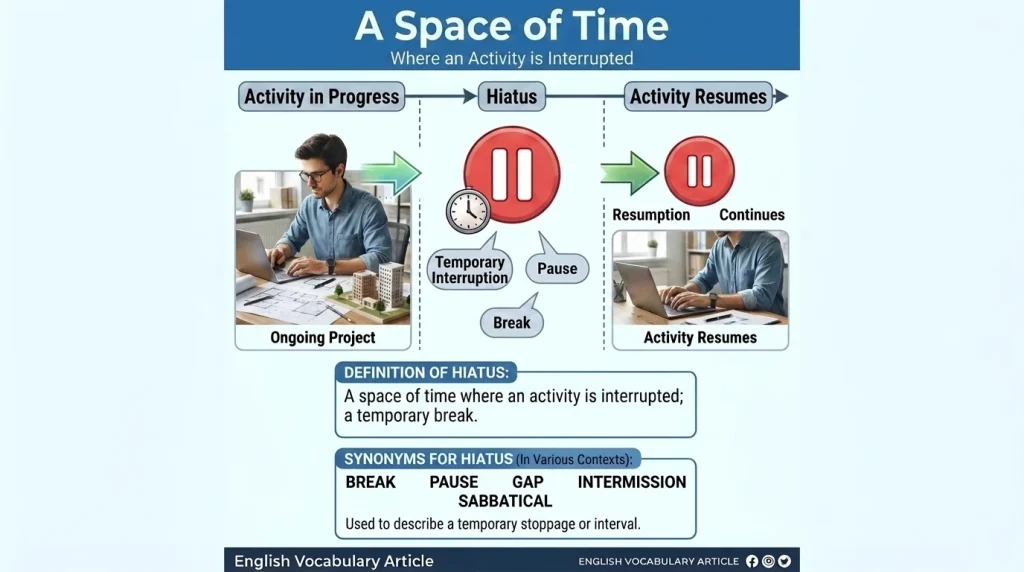
Learners often mistake hiatus for a permanent stop. It always implies that the activity will eventually resume. Avoid saying “a permanent hiatus,” as that creates a contradiction in terms.
Another mistake is confusing hiatus with vacation. A vacation involves leisure travel, whereas a hiatus simply means work or activity has paused. Native speakers often pair the word with “go on” (e.g., “The band went on hiatus”).
For more vocabulary breakdowns, check out our guide on professional language choices.
📝 10 MCQs — Synonym for Hiatus
1. What is the closest synonym for “hiatus”?
A) Break
B) Beginning
C) Celebration
D) Movement
2. “The project went on a hiatus.” What does this mean?
A) The project was temporarily paused.
B) The project was completed.
C) The project became successful.
D) The project started immediately.
3. Which word can replace “hiatus” in “The show returned after a long hiatus”?
A) Pause
B) Success
C) Journey
D) Result
4. What does “hiatus” usually refer to?
A) A temporary break or interruption
B) A permanent ending
C) A sudden beginning
D) A major achievement
5. Which is a synonym for “hiatus”?
A) Intermission
B) Progress
C) Completion
D) Arrival
6. “The band took a two-year hiatus.” This means the band:
A) Took a temporary break
B) Released an album
C) Started touring
D) Became more popular
7. Which word is closest in meaning to “hiatus” in a work schedule?
A) Break
B) Deadline
C) Promotion
D) Assignment
8. Which sentence uses “hiatus” correctly?
A) The program returned after a six-month hiatus.
B) The program began its hiatus with a new launch.
C) The hiatus increased the program’s speed.
D) The hiatus means the program was permanently successful.
9. Which option is NOT a synonym for “hiatus”?
A) Pause
B) Break
C) Interruption
D) Continuation
10. A temporary stop in an activity is called a:
A) Hiatus
B) Beginning
C) Destination
D) Conclusion
✅ Answer Key
- A
- A
- A
- A
- A
- A
- A
- A
- D
- A
Application Task: Write one short sentence describing your current work or study schedule using the word respite or interlude. ✍️
Frequently Asked Questions ❓
1. What is the most common synonym for hiatus in everyday speech?
The most common daily synonym for hiatus is “break” or “pause.” While hiatus sounds formal or professional, terms like “break” fit naturally into casual, everyday conversations without sounding overly academic or dramatic.
2. Can hiatus be used to describe a career break?
Yes, hiatus is frequently used to describe a temporary pause in someone’s career. Professionals often say they are taking a career hiatus to travel, study, or focus on personal family goals before returning to work.
3. What is the difference between a hiatus and a sabbatical?
A hiatus is any general temporary break in activity. A sabbatical is an official, often paid, extended leave granted specifically to teachers, professors, or corporate employees for rest, research, or travel.
4. Is it correct to say a temporary hiatus?
While people often say “temporary hiatus,” it is technically redundant. The word hiatus already means a temporary break. However, native speakers frequently use the phrase in informal and professional settings for extra emphasis.
5. What is a formal legal synonym for hiatus?
In legal contexts, words like “abeyance” or “moratorium” replace hiatus. Abeyance refers to conditions held in temporary disuse, while a moratorium refers to an official, legally authorized delay or temporary ban on an activity.
Conclusion 🌟
Expanding your English vocabulary with rich synonyms transforms everyday communication. 🗣️ Replacing simple words with precise alternatives like respite, interlude, or moratorium helps you express exact emotions and contexts effortlessly.
Bloggers, students, and professionals benefit greatly from using varied words. ✍️ It prevents repetitive writing, improves readability, and makes your essays, articles, and emails sound polished and engaging to readers.
Try using two new synonyms from this guide in your personal journals or workplace emails today! 🚀 Consistent practice is the fastest way to build natural fluency and confidence in spoken and written English.

Sophia Carter is the founder and lead writer at SynonymVerse.com, a trusted online resource dedicated to English vocabulary and effective communication. She is passionate about helping students, writers, professionals, and lifelong learners find the most accurate words to express their ideas with clarity and confidence.
At SynonymVerse.com, every article is carefully researched and thoughtfully written to provide reliable guidance on synonyms, word meanings, and vocabulary. With a strong focus on accuracy, real-world usage, and easy-to-understand explanations, the website is committed to helping readers strengthen their language skills, enrich their vocabulary, and become more confident communicators.