“Synonym for hang out” is a phrase every learner needs to refresh their daily English vocabulary. Imagine planning a relaxing weekend with close friends. Saying you want to hang out works fine, but using varied phrases makes your speech far more engaging.
“Synonym for hang out” helps you match your exact mood and setting. For instance, you might chill with friends at a cafe or network with colleagues after work. Choosing the right words makes your social plans clear.
Learning a synonym for hang out transforms basic English into vibrant speech. Students, bloggers, content writers, and daily speakers can easily avoid boring, repetitive phrasing. Fresh vocabulary helps you connect better with any audience.
What Does “Hang Out” Really Mean?
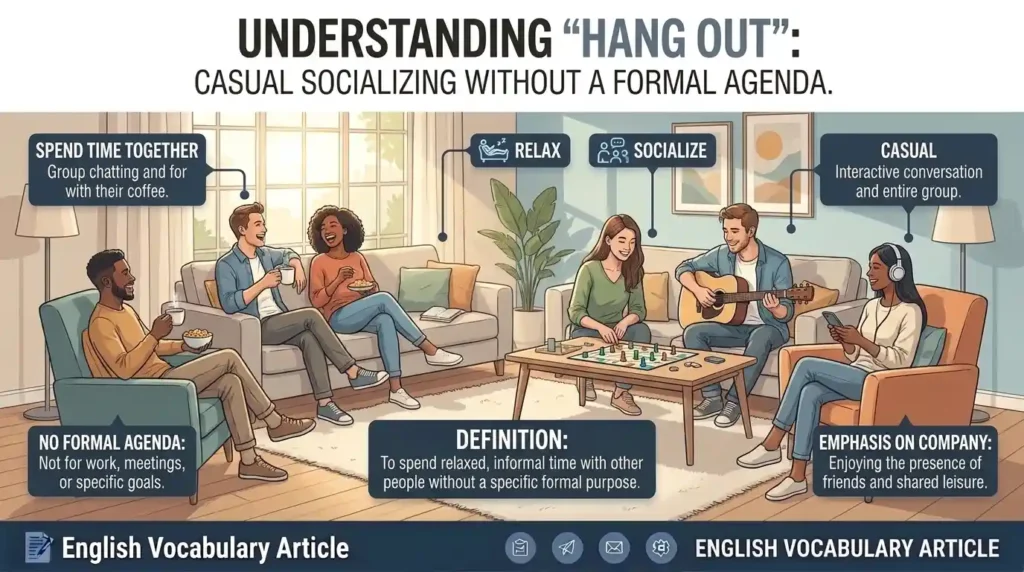
“Hang out” is an informal phrasal verb. It means to spend leisure time socialising or relaxing without a specific goal. Native speakers use it to describe low-pressure social time with friends, family, or peers.
The emotional tone is relaxed, friendly, and casual. It rarely fits strict professional or formal settings.
- Part of Speech: Phrasal Verb
- Definition: To spend time in a particular place or with specific people socially.
Connotative Meaning
(Connotation refers to the emotional feeling or idea that a word evokes beyond its literal dictionary definition.)
- Positive tone: Expresses warm connection, relaxation, and friendly bonding.
- Negative tone: Can imply laziness, wasting time, or slacking off if used critically.
- Neutral tone: Simply describes spending unstructured time in a location.
Etymology
The verb “hang” comes from Old English hangian (to suspend). The combined phrasal verb “hang out” emerged in 19th-century American English, originally meaning to reside or frequent a place. By the mid-20th century, it became popular slang for socialising casual style.
- Old English (450–1100): Hangian referred strictly to physical suspension.
- Middle English (1100–1500): Hangen expanded in local dialects but kept physical meanings.
- Modern English (1500–Present): Evolved into mid-20th-century slang for unstructured social gathering.
Pronunciation (US & UK)
- US: /hæŋ aʊt/
- UK: /hæŋ aʊt/
Syllables & Structure
- Syllables: hang-out
- Root: hang
- Prefix: None
- Suffix: None (combined with the particle “out”)
Synonyms List
Chill (Verb) — US: /tʃɪl/ | UK: /tʃɪl/
- Meaning: To relax completely without stress or formal plans.
- Tone/Register: Informal / Casual
- Example 1: We plan to chill at the park this afternoon.
- Example 2: She likes to chill after a long workday.
Socialise (Verb) — US: /ˈsoʊ.ʃə.laɪz/ | UK: /ˈsəʊ.ʃə.laɪz/
- Meaning: To participate in activities with other people in a friendly way.
- Tone/Register: Neutral / Standard
- Example 1: It is healthy to socialise with your neighbours.
- Example 2: They socialise often during the summer holidays.
Gather (Verb) — US: /ˈɡæð.ɚ/ | UK: /ˈɡæð.ər/
- Meaning: To come together as a group in one place.
- Tone/Register: Neutral / Formal
- Example 1: Families gather around the dinner table every evening.
- Example 2: Students gather outside the hall after exams.
Meet up (Phrasal Verb) — US: /miːt ʌp/ | UK: /miːt ʌp/
- Meaning: To encounter someone by agreement to spend time together.
- Tone/Register: Informal / Friendly
- Example 1: Let us meet up at the coffee shop tomorrow.
- Example 2: I will meet up with my team after lunch.
Assemble (Verb) — US: /əˈsem.bəl/ | UK: /əˈsem.bəl/
- Meaning: To fit or collect people together in a structured group.
- Tone/Register: Formal / Academic
- Example 1: The team members assemble in the main hall.
- Example 2: Citizens assemble annually for the parade.
Congregate (Verb) — US: /ˈkɑːŋ.ɡrə.ɡeɪt/ | UK: /ˈkɒŋ.ɡrɪ.ɡeɪt/
- Meaning: To gather together into a crowd or large group.
- Tone/Register: Formal / Written
- Example 1: People tend to congregate near the city square.
- Example 2: Birds congregate on the lakeshore during spring.
Lounge (Verb) — US: /laʊndʒ/ | UK: /laʊndʒ/
- Meaning: To lie, sit, or stand in a relaxed or lazy way.
- Tone/Register: Casual / Informal
- Example 1: They lounge by the swimming pool every weekend.
- Example 2: He loves to lounge on the sofa on Sundays.
Loiter (Verb) — US: /ˈlɔɪ.t̬ɚ/ | UK: /ˈlɔɪ.tər/
- Meaning: To stand or wait around without an obvious purpose.
- Tone/Register: Negative / Legal
- Example 1: Teenagers often loiter near the shopping mall entrance.
- Example 2: Signs warn people not to loiter around the station.
Mingle (Verb) — US: /ˈmɪŋ.ɡəl/ | UK: /ˈmɪŋ.ɡəl/
- Meaning: To move around and talk to different people at a event.
- Tone/Register: Neutral / Business Casual
- Example 1: She loves to mingle with guests at dinner parties.
- Example 2: Try to mingle during the conference networking break.
Associate (Verb) — US: /əˈsoʊ.si.eɪt/ | UK: /əˈsəʊ.si.eɪt/
- Meaning: To connect or spend time with someone socially or professionally.
- Tone/Register: Formal / Academic
- Example 1: He prefers to associate with creative artists.
- Example 2: They associate closely through work projects.
Network (Verb) — US: /ˈnet.wɝːk/ | UK: /ˈnet.wɜːk/
- Meaning: To interact with others to exchange information and professional contacts.
- Tone/Register: Professional / Business
- Example 1: Professionals network during annual trade shows.
- Example 2: I plan to network with software developers tonight.
Unwind (Verb) — US: /ʌnˈwaɪnd/ | UK: /ʌnˈwaɪnd/
- Meaning: To stop worrying and relax after a period of work.
- Tone/Register: Neutral / Positive
- Example 1: Listening to music helps me unwind after work.
- Example 2: We unwound with cold drinks by the beach.
Catch up (Phrasal Verb) — US: /kætʃ ʌp/ | UK: /kætʃ ʌp/
- Meaning: To talk to someone to learn their news after not seeing them.
- Tone/Register: Informal / Warm
- Example 1: Let us catch up over dinner this Friday evening.
- Example 2: She caught up with old school friends yesterday.
Kick back (Phrasal Verb) — US: /kɪk bæk/ | UK: /kɪk bæk/
- Meaning: To relax completely and enjoy free time without effort.
- Tone/Register: Informal / Slang
- Example 1: We plan to kick back and watch movies tonight.
- Example 2: Kick back and enjoy your weekend break.
Fraternise (Verb) — US: /ˈfræt̬.ɚ.naɪz/ | UK: /ˈfræt.ə.naɪz/
- Meaning: To associate or form a friendship with someone, often despite rules.
- Tone/Register: Formal / Institutional
- Example 1: Officers should not fraternise with junior staff.
- Example 2: The players fraternise after the final match.
Hobnob (Verb) — US: /ˈhɑːb.nɑːb/ | UK: /ˈhɒb.nɒb/
- Meaning: To spend time socialising with wealthy or famous people.
- Tone/Register: Informal / Slightly Critical
- Example 1: He likes to hobnob with local politicians at galas.
- Example 2: She hobnobbed with celebrities during the film festival.
Rendezvous (Verb) — US: /ˈrɑːn.deɪ.vuː/ | UK: /ˈrɒn.deɪ.vuː/
- Meaning: To meet at an agreed time and place.
- Tone/Register: Formal / Literary
- Example 1: The group will rendezvous at the city centre gate.
- Example 2: We arranged to rendezvous near the library fountain.
Visit (Verb) — US: /ˈvɪz.ɪt/ | UK: /ˈvɪz.ɪt/
- Meaning: To go to see a person or place for social reasons.
- Tone/Register: Standard / Neutral
- Example 1: I plan to visit my cousins over the weekend.
- Example 2: They visit the art museum regularly.
Connect (Verb) — US: /kəˈnekt/ | UK: /kəˈnekt/
- Meaning: To establish a good relationship or meaningful bond with someone.
- Tone/Register: Neutral / Positive
- Example 1: Board games help families connect without technology.
- Example 2: We connected instantly over shared hobbies.
Rub shoulders (Idiom) — US: /rʌb ˈʃoʊl.dɚz/ | UK: /rʌb ˈʃəʊl.dəz/
- Meaning: To meet and spend time with famous or important people.
- Tone/Register: Informal / Idiomatic
- Example 1: Reporters rub shoulders with athletes at media events.
- Example 2: You might rub shoulders with stars in Hollywood restaurants.
Pal around (Phrasal Verb) — US: /pæl əˈraʊnd/ | UK: /pæl əˈraʊnd/
- Meaning: To spend time friendly together as close buddies.
- Tone/Register: Informal / Friendly
- Example 1: The boys love to pal around in the neighborhood.
- Example 2: We palled around together during summer camp.
Chill out (Phrasal Verb) — US: /tʃɪl aʊt/ | UK: /tʃɪl aʊt/
- Meaning: To spend time in a peaceful and completely relaxed manner.
- Tone/Register: Informal / Casual
- Example 1: Let us chill out by the campfire tonight.
- Example 2: I need a quiet room to chill out.
Keep company (Idiom) — US: /kiːp ˈkʌm.pə.ni/ | UK: /kiːp ˈkʌm.pə.ni/
- Meaning: To stay with someone so that they do not feel lonely.
- Tone/Register: Warm / Standard
- Example 1: I stayed home to keep my grandmother company.
- Example 2: She kept him company while he waited for the bus.
Hang around (Phrasal Verb) — US: /hæŋ əˈraʊnd/ | UK: /hæŋ əˈraʊnd/
- Meaning: To spend time somewhere doing very little productive work.
- Tone/Register: Casual / Neutral
- Example 1: Don’t just hang around the house all day.
- Example 2: They hang around the park after school ends.
Convene (Verb) — US: /kənˈviːn/ | UK: /kənˈviːn/
- Meaning: To come together or cause assemble for a formal purpose.
- Tone/Register: Formal / Official
- Example 1: The board members will convene at noon sharp.
- Example 2: Committee delegates convene every month for reviews.
Mix (Verb) — US: /mɪks/ | UK: /mɪks/
- Meaning: To socialise with people from various backgrounds comfortably.
- Tone/Register: Neutral / General
- Example 1: She finds it easy to mix with new colleagues.
- Example 2: Students mix freely during orientation week.
Spend time (Phrase) — US: /spend taɪm/ | UK: /spend taɪm/
- Meaning: To pass hours or days in a particular social activity.
- Tone/Register: Standard / Neutral
- Example 1: I want to spend time with my family today.
- Example 2: They spend time reading together every evening.
Knock about (Phrasal Verb) — US: /nɑːk əˈbaʊt/ | UK: /nɒk əˈbaʊt/
- Meaning: To travel around or relax casually without strict plans.
- Tone/Register: Informal (UK/Commonwealth)
- Example 1: We spent Sunday knocking about the old town market.
- Example 2: He likes to knock about in his garage on weekends.
Pass time (Phrase) — US: /pæs taɪm/ | UK: /pɑːs taɪm/
- Meaning: To do something amusing while waiting for time to pass.
- Tone/Register: Neutral / General
- Example 1: We played cards to pass time during the flight.
- Example 2: Reading novels is a pleasant way to pass time.
Schmooze (Verb) — US: /ʃmuːz/ | UK: /ʃmuːz/
- Meaning: To talk casually and persuasively to gain personal advantage.
- Tone/Register: Informal / Persuasive
- Example 1: Executives schmooze with clients during golf matches.
- Example 2: He schmoozed his way into the VIP lounge.
Cluster (Verb) — US: /ˈklʌs.tɚ/ | UK: /ˈklʌs.tər/
- Meaning: To group together closely in a small physical space.
- Tone/Register: Neutral / Descriptive
- Example 1: Tourists cluster around the famous historical monument.
- Example 2: Children cluster together during outdoor game times.
Flock (Verb) — US: /flɑːk/ | UK: /flɒk/
- Meaning: To move or gather together in large enthusiastic numbers.
- Tone/Register: Expressive / Descriptive
- Example 1: Fans flock to the stadium every Saturday afternoon.
- Example 2: Visitors flock to beaches during warm summer days.
Rally (Verb) — US: /ˈræl.i/ | UK: /ˈræl.i/
- Meaning: To unite or come together for a common purpose or support.
- Tone/Register: Energetic / Group-oriented
- Example 1: Neighbors rally together to organize clean-up events.
- Example 2: Friends rallied around her after the difficult news.
Intersect (Verb) — US: /ˌɪn.t̬ɚˈsekt/ | UK: /ˌɪn.təˈsekt/
- Meaning: To cross paths or meet socially at a shared point.
- Tone/Register: Academic / Literary
- Example 1: Our social circles intersect at local community events.
- Example 2: Their lives intersected during university study groups.
Reconnect (Verb) — US: /ˌriː.kəˈnekt/ | UK: /ˌriː.kəˈnekt/
- Meaning: To meet again and rebuild a bond after period apart.
- Tone/Register: Warm / Positive
- Example 1: Old classmates reconnect at their annual reunion party.
- Example 2: I want to reconnect with my childhood best friend.
Sit around (Phrasal Verb) — US: /sɪt əˈraʊnd/ | UK: /sɪt əˈraʊnd/
- Meaning: To spend time doing very little or sitting idly with others.
- Tone/Register: Casual / Unproductive
- Example 1: We sat around talking about life until midnight.
- Example 2: Don’t sit around when there is work to complete.
Troop (Verb) — US: /truːp/ | UK: /truːp/
- Meaning: To walk or move together in a large group like a unit.
- Tone/Register: Informal / Group
- Example 1: The children trooped into the kitchen for snacks.
- Example 2: We all trooped over to the local diner together.
Herd (Verb) — US: /hɝːd/ | UK: /hɜːd/
- Meaning: To move or collect people together as a single group.
- Tone/Register: Informal / Slightly Humorous
- Example 1: Tour guides herd tourists into the museum lobby.
- Example 2: She herded her friends toward the concert stage gates.
Rendezvous up (Phrasal Verb) — US: /ˈrɑːn.deɪ.vuː ʌp/ | UK: /ˈrɒn.deɪ.vuː ʌp/
- Meaning: To gather together at a designated spot informally.
- Tone/Register: Informal / Modern Slang
- Example 1: Let us rendezvous up near the north mall exit.
- Example 2: The hikers rendezvoused up before entering the trail.
Chillax (Verb) — US: /tʃɪˈlæks/ | UK: /tʃɪˈlæks/
- Meaning: To calm down and relax completely with friends.
- Tone/Register: Slang / Very Informal
- Example 1: Just chillax and enjoy the party atmosphere.
- Example 2: We spent the whole afternoon chillaxing at home.
Unchain (Verb) — US: /ʌnˈtʃeɪn/ | UK: /ʌnˈtʃeɪn/
- Meaning: To free oneself from daily duties to socialise.
- Tone/Register: Metaphorical / Literary
- Example 1: It is time to unchain ourselves from work routines.
- Example 2: They unchained their minds and enjoyed the vacation.
Socialise around (Phrase) — US: /ˈsoʊ.ʃə.laɪz əˈraʊnd/ | UK: /ˈsəʊ.ʃə.laɪz əˈraʊnd/
- Meaning: To circulate through a social space meeting different groups.
- Tone/Register: Conversational / Standard
- Example 1: He spends time socialising around during corporate dinners.
- Example 2: She loves socialising around her apartment complex.
Hang (Verb) — US: /hæŋ/ | UK: /hæŋ/
- Meaning: Shortened form meaning to spend casual time with friends.
- Tone/Register: Slang / Youth culture
- Example 1: Do you want to hang with us after class?
- Example 2: We are hanging at Mark’s house today.
Gather round (Phrasal Verb) — US: /ˈɡæð.ɚ raʊnd/ | UK: /ˈɡæð.ər raʊnd/
- Meaning: To assemble closely in a circle around someone or something.
- Tone/Register: Warm / Storytelling
- Example 1: The kids gathered round to listen to the story.
- Example 2: Neighbors gathered round to celebrate the win.
Commingle (Verb) — US: /kəˈmɪŋ.ɡəl/ | UK: /kəˈmɪŋ.ɡəl/
- Meaning: To blend or mix together socially across groups.
- Tone/Register: Formal / Academic
- Example 1: Festival events allow diverse cultures to commingle.
- Example 2: Guests commingled in the main garden area easily.
Synonyms by Tone
Choosing the right word depends heavily on your audience and setting. Here is how these alternatives fall into different categories:
- Positive / Warm Tone: Catch up, Reconnect, Unwind, Keep company, Gather round.
- Neutral Tone: Socialise, Gather, Meet up, Visit, Mix, Spend time.
- Negative / Critical Tone: Loiter, Sit around, Sludge around, Waste time.
- Playful / Informal Tone: Chill, Kick back, Pal around, Chillax, Hang.
- Formal / Professional Tone: Convene, Congregate, Assemble, Network, Commingle.
Tone matters because using “loiter” instead of “meet up” changes a friendly invitation into a complaint. Similarly, telling your boss you want to “chillax” sounds unprofessional compared to “networking.”
Mini Comparison
| Feature | Hang Out | Network | Convene |
| Meaning | Casual leisure time with friends | Professional socialising for career growth | Formal meeting for an official agenda |
| Tone | Informal & relaxed | Professional & intentional | Official & structured |
| Best Use | Weekends, cafes, parties | Conferences, business dinners | Board meetings, formal assemblies |
Context-Based Usage
- Daily Conversation: Use options like chill, meet up, or catch up when making simple plans with friends or family.
- Writing or Blogging: Words like socialise, gather, or connect sound natural in lifestyle articles and essays without sounding too slangy.
- Professional Tone: Opt for network, convene, or assemble in emails, reports, and workplace conversations.
- Creative Writing: Use evocative options like congregate, flock, or rendezvous to set a vivid scene in stories.
Common Mistakes & Native Usage
Learners often use casual slang like “hang out” in professional settings. Writing “I want to hang out with the directors” in a cover letter sounds overly informal. Use “connect” or “network” instead.
Another common mistake is confusing “hang out” with “loiter.” “Hang out” is a positive or neutral social action. “Loiter” carries a negative legal meaning, suggesting someone is waiting around suspicious spaces.
Real-Life Mini Scenarios
- Workplace: “Let us network with the visiting team during lunch break.”
- Social Situations: “We should meet up at the park to catch up on news.”
- Media / Pop Culture: “Celebrities love to hobnob at exclusive red carpet events.”
- Creative Writing: “Flocks of travelers congregated beneath the old station clock.”
Conclusion
Expanding your vocabulary beyond a single phrase elevates your conversational skills. Using tailored choices like unwind, network, or convene gives your English precision and polish.
Mastering varied words allows you to adapt instantly to both formal offices and casual coffee shops. This flexibility makes your writing and speaking far more natural to native speakers.
Try using two new alternatives from this list in your next email or chat conversation. Regular practice builds confidence and brings your everyday English expression to life.
Practice Quiz
- Which word fits best in a professional business email?
A) Chillax
B) Network
C) Hang out
D) Pal around - What is the tone of the word “Loiter”?
A) Highly positive
B) Formal and polite
C) Negative or suspicious
D) Playful slang - Which phrase best describes meeting an old friend to hear their recent news?
A) Convene
B) Catch up
C) Loiter
D) Assemble - Choose the most formal synonym for a group coming together officially.
A) Kick back
B) Hang
C) Convene
D) Chill - Which word carries a very informal, slang tone?
A) Socialise
B) Congregate
C) Chillax
D) Associate - What phrase works best when talking about staying with an older people relative so they are not lonely?
A) Keep company
B) Loiter
C) Schmooze
D) Flock - “Network” is most appropriate in which context?
A) A lazy Sunday morning at home
B) A corporate industry conference
C) A children’s playground
D) A late-night movie theater session - Which word suggests moving in large, enthusiastic crowds?
A) Unwind
B) Flock
C) Loiter
D) Schmooze - Choose the best option for relaxing after a hard day of work.
A) Assemble
B) Unwind
C) Convene
D) Congregate - Which synonym implies socialising specifically to gain personal or career benefits?
A) Meet up
B) Visit
C) Schmooze
D) Gather
Reflection Task: Write one short sentence about your ideal weekend using your favorite new synonym from this article.
Answer Key: 1-B, 2-C, 3-B, 4-C, 5-C, 6-A, 7-B, 8-B, 9-B, 10-C
FAQs
What is the most formal synonym for hang out?
“Convene” and “assemble” are the most formal alternatives. Use them in corporate, academic, or legal settings where structured group meetings take place.
Is it acceptable to use hang out in business emails?
It is usually too informal for professional correspondence. Replace it with phrases like “meet up,” “connect,” or “network” to maintain professional boundaries.
What is the difference between hang out and chill?
Both are informal, but “chill” places a stronger emphasis on relaxing and resting, whereas “hang out” focuses mainly on spending social time together.
What is a good slang alternative to hang out for youth culture?
“Chill,” “hang,” and “kick back” are popular, widely understood slang choices among younger English speakers for casual social plans.
How does loiter differ from hanging out?
“Hang out” is positive or neutral social spending of time. “Loiter” carries a negative tone, often meaning staying in a public area without permission or purpose.

Sophia Carter is the founder and lead writer at SynonymVerse.com, a trusted online resource dedicated to English vocabulary and effective communication. She is passionate about helping students, writers, professionals, and lifelong learners find the most accurate words to express their ideas with clarity and confidence.
At SynonymVerse.com, every article is carefully researched and thoughtfully written to provide reliable guidance on synonyms, word meanings, and vocabulary. With a strong focus on accuracy, real-world usage, and easy-to-understand explanations, the website is committed to helping readers strengthen their language skills, enrich their vocabulary, and become more confident communicators.